Disclaimer: This blog may contain affiliate links. I may receive a commission if you click a link and purchase something within this site. As an Amazon Associate I earn from qualifying purchases.

Monday, February 16, 2015

Tiger Barbs - Aquarium Fish


This is another excellent addition for most community aquariums, as they generally do well with a large variety of fish. The Tiger Barbs are a dedicated "group fish," though, and things can change in a bad way if they are kept in a community tank only as a pair or as an individual. Actually, they need to be in groups of 5 or more, in my opinion. The reason for this, is that they are pesky little devils and are notorious for being fin-nippers and whatnot. Slow moving fish like the Gouramis and Bettas, for example, may not take too kindly to a bored Tiger Barb that doesn't have many friends. Let's just say, that your pretty little Betta may be minus most of its fins, in a couple of days; ha!

In general, when you have a nice school of Tiger Barbs, they will spend the majority of their time playing with each other as opposed to acting like little mini piranhas. Much like the Giant Danio fish, they are extremely active and help add life and motion to any fish tank that has a respectable size. The tiger barbs are small and usually don't grow much past 2 inches long. The second picture I used for this post, shows the green tiger barbs albeit I still like the common tiger barbs the best. Overall, this type of tropical fish is quite hardy. Oh, if you do have a highly competitive community tank full of aggressive fish, don't worry about the tiger barbs not being able to compete for food. They are so nimble and quick, as they can snatch up food particles like a vacuum. Hmm, I've seen humans like that before; LOL!

Image Credit: Wikimedia Commons. Source = en.wikipedia.org/wiki/Tiger_barb

---End of Post "Tiger Barbs - Aquarium Fish"

Giant Danio - Aquarium Fish

On this post, I'm talking about a very active, busy fish known as the Giant Danio.

Now, unlike a lot of tropical fish, this one isn't known for being attractive and colorful. They are like the busy-bees of the tank. It is almost required and/or it is a necessity that you only buy these in groups of 3 or 4 or more. They truly are a 'group fish' (sort of like how the Tiger Barbs do best in groups) and they will be extremely sad and depressed if they are kept in solitude. Seriously, they will only stick to their own kind and that is just the way they roll. To me, they look more like a creek minnow, but unlike a common minnow, they prefer warm waters (tropical fish; duh!).

They are a close relative to the Zebrafish and the Pearl Danio, but that is neither here nor there. These swimming fanatics swim constantly. Back and forth, back and forth... In fact, the ones I had seemed to never sleep, for the most part. It didn't matter if it was in the middle of the night with the lights off, while all the other fish in my community tank were sleeping, they would be consistently making their laps. The point is, they can fill the activity gap in a community tank that is full of variety. Have you ever seen a boring, lifeless fish tank full of lazy fish before? Well, not if you have Giant Danios in there! They are excellent jumpers, too. They hit the food almost as soon as it lands on the water surface, sort of like a cold-water bass. I can't count the amount of times they have splashed water on me when I was feeding the fish. Crazy bastards; ha!

The textbook lifespan for the Giant Danios often state that they only live a couple of years, but that is wrong. I've had them live for several years, even to the point to where they became hump back. Bottom Line: They are not the prettiest fish, but they are one of the more active ones; cheers!

Image Credit: Wikimedia Commons. Source = en.wikipedia.org/wiki/Giant_danio

---End of Post "Giant Danio - Aquarium Fish"

Corydoras - Aquarium Fish - Bottom Feeder

This cool fish is a tropical catfish in the armored catfish family and is the best bottom feeder I have ever had for my freshwater aquariums. As you know, any uneaten food particles collect at the bottom of your fish tank and if they are not consumed, they will literally rot and make your water cloudy and polluted. Of course, if you have a well-established aquarium there should be enough healthy bacteria in there to prevent the cloudy water, within reason, but it will still ultimately raise your nitrate and nitrite levels in a hurry.

This is why it is important to have a certain number of scavengers and bottom feeders in your community aquariums. The Bala Sharks I have previously written about are not generally praised for being scavengers, but they also go around with their sucker-like mouths at the bottom of the tank while keeping your gravel clean - especially when they are hungry in between feeding times, but the Corydoras are the best at this that I've seen. This is all they do besides sleep and lay the occasional set of eggs. They are busy little catfishes, to say the least. I do recommend some type of shelter, big rocks, plants, or cave for them because they prefer to sleep under stuff.

That reminds me, the Corydoras are often called Cories, Cory Cats and/or Cory Catfish. There are various types of them, but they all look fairly similar between each species. As a side note, they are best kept in pairs, at the very least.  I would not just buy one of them, as they really appreciate companionship with their own kind. I had two in my community tank for years, and they always stuck together, like two peas in a pod. Ha!

Anyway, if you have a decent-sized tank that requires multiple feedings throughout the day, don't forget to add these excellent bottom feeders to your aquarium. They can save you many water changes over time; cheers!

Image Credit: Wikimedia Commons. Source = en.wikipedia.org/wiki/Corydoras

---End of Post "Corydoras - Aquarium Fish - Bottom Feeder"

Plecostomus - Aquarium Fish - Giant Algae Eater

When it comes to freshwater aquariums and problems with algae growth within your tank, the Plecostomus makes the need for magnetic glass cleaners obsolete. This is by far the best microscopic scavenger you will ever find. This giant algae eater, commonly called the Pleco, is a sucker catfish that is native to the Central and South American fresh waters. They are not even in the same league as those little Chinese Algae Eaters (never liked them anyway), as these Plecostomus sucker-freaks can not only totally rid your tank from algae, they will basically eat any leftover food you can dish out - including dead fish and/or anything that happens to die overnight; ha!

The negative, when concerning community tanks, is that they really don't have much of a personality, they like to be left alone, and act sort of like a living machine that only sleeps and works/eats with no play. The other shortcomings are not so short, as the fish can often grow too large for a regular tank! I've heard of them growing 2 feet long before, so if you only have a 29-gallon tank or less, for example, you do the math.

They are very hardy/tough, too. I've seen them survive in bad conditions when others have flopped. Not that keeping a tank under poor conditions is recommended, but such things can happen with the slightest mishap and during brief bouts of neglect. At any aquatic rate, if you are looking for a remedy for your algae problems, this is the one you need to add to your aquarium! I mean literally "one," as you will only need 1 per tank and it's not a good idea to add more Plecos for this style of competition in any semi-normal tank; trust me... :)

Update: Evidently, they have a decent lifespan, as well.  I gave one of these away to a friend of mine several years ago, and that thing is still alive.  Let me see... I had it for about 4 years, then gave it away. The person I gave it to has now had it for 13 years. Good grief, that means that fish is 17 years old! Maybe it's a record because I just checked on a few sources on the Internet concerning the longevity of this fish and they all say 10 to 15 years in captivity.  Either way, that is pretty good for an aquarium fish, to say the least. ---End of Update

If you are fairly new to the aquarium hobby and would like some beginner tips, visit an old blog post of mine, here: perpendicularity.org/blog/2010/05/04/freshwater-aquariums-a-scenic-decorative-hobby/ [Link is no longer active, but that post has been moved here: "New Tank Syndrome."]

Image Credit: Wikimedia Commons - Source = en.wikipedia.org/wiki/Loricariidae

---End of Post "Plecostomus - Aquarium Fish - Giant Algae Eater"

One of the Best Foods for Freshwater Aquariums

This is more or less an opinion post, but out of all the years I had several freshwater aquariums in my home, freeze-dried bloodworms was by far the best food I ever used. Unlike the flake foods, tablets, and pellets, there is not very much waste involved, if any. They don't disintegrate into tiny bits like a lot of fish food does, and you don't have to hope the bottom feeders and scavengers find all of the waste particles buried in the gravel. Actually, if you use freeze-dried bloodworms too often, you will have to feed your scavengers separately, with sinking pellets, algae discs, etc.

Anyway, if you have a community tank with a variety of fish, you can simply tell which foods they like the best by how excited they get during feeding times. The warmer the water gets, the more voracious their appetite becomes, too. Another food that really tickled their fancies, was freeze-dried plankton, but it is mainly for the bigger fish. Even the small fish can consume the bloodworms. Now, I wouldn't recommend solely feeding your fish freeze-dried bloodworms. Like humans, they still need some variety in their diet for optimal health, unless they are strictly algae-eaters, but even some of those still like to eat other things. Another reason is that bloodworms and the freeze-dried plankton I mentioned earlier, are all really high in protein. Some fish do not need to stay on a high protein diet, as their organs may eventually fail. If in doubt, educate yourself about each fish in your tank(s).

At any aquatic rate, flake food is typically well balanced; shrimp pellets and tablets are really messy and require more scavengers and/or water changes, but freeze-dried bloodworms and plankton is the best in my opinion and, if anything, it makes for a good treat for your cold-blooded friends from time to time; cheers!

Image Credit: Fair Use - Product Image. This image is found on various websites and catalogs.

---End of Post "One of the Best Foods for Freshwater Aquariums"

The Betta: Siamese Fighting Fish

This is one of the most popular fish for tropical, freshwater aquariums. A lot of people love these splendid creatures! Personally, I only bought a few of them during the years that I was big into fish tanks. I was the oddball, evidently, albeit I just preferred the other fish varieties. When it comes to the Siamese Fighting Fish, they often have this bad reputation for being vicious and aggressive. I have never understood that. The only thing you have to watch, is when you have two males involved/together. It is best to keep the males in separate tanks, but you can have all of the female Betta fish you can comfortably fit into your tanks, with no problems at all. 

I remember being at a store that sold aquarium fish several years back, and this guy came up to the tanks, pointed at the tiny Bettas, then pointed at another tank that had large-sized Koi and Goldfish in there and said, "that little Betta would beat down every fish in there." I almost died laughing at this guy's ignorance, but tried to keep it in. I was just like, "Oh, really. That's nice." I could have told him that I've seen them get their ass handed to 'em by little friendly community fish before, but elected to let it go because I was trying to shop. What a complete moron. Anyway...

The male Betta fish is way more colorful than the females. They have long fins and if you have them in a community tank, it is best not to have little pesky fish like Tiger Barbs in there or they will nip them to death. I know, I've seen it happen before. That reminds me... The biggest thing that bothers me about the Siamese Fighting Fish, is the constant promotion of how they can live in a little cup or bowl. Sure, they can, but would you like to live inside of a little tee-tiny, itty-bitty container?

The reason why they can live in such a small space is because they are a "labyrinth fish," as they have an auxiliary set of lungs to help their gills out. These "lungs" enable the Betta to live in a small receptacle, as they can literally come up for air. They are also bubblenest builders, which is a method they use to provide a nest for their fry via blowing bubbles at the surface. However, my favorite type of labyrinth fish/bubblenest builder is not the Siamese Fighting Fish, though, as I always preferred the Gouramis over them. I'll most likely write a post about the Gourami fish in the future, so that is all I'll say about that for now.

The bottom line: The Betta is a pretty fish that is easily managed and, in my opinion, is overrated. They are just too delicate for my liking, but they would be an excellent starter fish for little kids and tanks that are only 10 gallons or smaller (just not too small!).

Image Credit: Wikimedia Commons. Source = en.wikipedia.org/wiki/Siamese_fighting_fish

---End of Post "The Betta: Siamese Fighting Fish"

Red-tailed Shark - Aquarium Fish

First of all, whoever named this particular aquarium fish a "shark," must have really been highly imaginative or confused, to say the least. Unlike the tropical fish known as the Bala Shark, the Red-tailed Shark doesn't even remotely resemble such a creature. I'm assuming they got their name because of their somewhat high dorsal fin, but good grief! Anyway, this is a very mild-mannered tropical fish. I have heard before that they can be a bit scrappy amongst each other, but the ones I had in a large community tank always minded their own business. Then again, there were big African Cichlids in the tank to keep everybody on their best behavior, too. Ha!

The red-tailed shark can be dull colored or a deep, rich color. I prefer the dark black ones with the bright red tails, but the one pictured here isn't so hot. If I still had my tanks, I'd take pictures from it. I may try to find some old pics if I can find the data discs around here. At any aquatic rate, this is an excellent fish for community tanks.  They do not get very big, either. I've read that they can grow up to 6 inches long (probably the ones kept in bigger tanks), but the ones I had where more in the 4-inch range. They are not picky eaters, either, which is always a plus. If you allow a decent amount of time in between feeding times, they are fun to watch when they get hungry, as the red-tailed shark will vivaciously scavenge the rocks and the live plants for any microscopic growth or crumbs, which also helps keep your tank clean and looking good.

So, if you're looking for a scavenger-type fish that is not a bottom feeder nor a suckerfish and/or algae eater, that actually has some type of personality, this may be a good choice for your community aquarium. Now, if you're looking for something that has more of the shark look, then the Bala that I linked to at the beginning of this post would be a better option.

Image Credit: Is in the Public Domain and is not under copyright. Source = en.wikipedia.org/wiki/Red-tailed_black_shark

---End of Post "Red-tailed Shark - Aquarium Fish"

Hornwort - Aquarium Plant

In my last post, I mentioned something about having fish for pets and my aquarium hobby. Well, I haven't had any fish tanks in a few years, but for several years I had many of them. At one time, one of my rooms looked like "aqua world." Ha! Anyway, I have a lot of experience with tropical fish and freshwater aquariums, but I used to never write about it for some reason. I may dedicate this month of February to all aquatic topics on this Wildlife & Nature Blog...

Anyway, most folks like plants in their aquarium. However, most people seem to think those fake, plastic plants are the way to go. To have a healthy environment for your fish population, it is an added bonus to include live plants. They not only provide additional oxygen and put less demand on air pumps and bubble makers (aerators), they also provide shelter for young fry, a place to lay eggs, food for some types of fish, and help balance the nitrogen cycle, and so on.

The plant I'm talking about today is called Hornwort. It was my favorite aquatic plant out of all the ones I tried. It grows really fast, has lush green growth, and turns your tank into a jungle if you don't trim it on occasions. You can buy a small amount from an aquarium/aquatic pet supplier, throw it into your tank, and watch it grow. I've had some come in before with snails attached, but they were all consumed by my fish, so it didn't matter. It grows from both ends, and you can trim, cut, and spread it out accordingly. I liked to let mine grow in long strands, as I preferred lots of green growth that wasn't algae.

Hornwort often floats around at the surface, so it does block a good bit of light when it starts getting big. This can be a good thing if you don't have very many algae eaters in your tank, as that will sort of help keep that in check, as well. Another added benefit for having a fast growing plant like Hornwort in your tank, is that when you have to periodically remove a lot of it, you are also removing some of the built-up nitrogen/nitrates that accumulate in your aquarium. Yeah, the waste cycle goes from ammonia to nitrites to the less harmful nitrates, but it is good to keep the cycle flowing for healthy fish. Of course, a good supply of healthy bacteria that is naturally found in established tanks will quickly convert the waste into nitrate, and semi-regular water and filter changes will keep that in check, also.

The one thing you need to watch out for, when you have a tank full of Hornwort, is the pH level. This particular aquarium plant tends to lower your pH, as it pulls the nutrients and trace minerals from the water to sustain its fast growth. Okay, well, I thought I'd share that today, in case anybody is out there searching for a good aquarium plant; cheers!

Image Credit: Using the 'free to use & share' Google Image Search function.

---End of Post "Hornwort - Aquarium Plant"

New Tank Syndrome: Adding Healthy Bacteria to your Aquarium

This will now be a 2-part post since I recently deleted an old website of mine. I've been re-posting articles amid multiple blogs of mine lately, and have combined some posts that are related, etc.

Part 1: "Freshwater Aquariums – A scenic, decorative hobby…"

An aquatic delight, which brings animated beauty that can enliven any home, room or area...

Other than the obvious supplies and fish, what's mainly required is: responsibility, special care, and an ongoing interest in this splendid, creative hobby.

Before you begin…

If you’re new to this, don’t jump right in without giving it some thought. It’s amazing how many people lose interest in a whim, after finding out there is a little effort and care involved. I really think some people believe that an aquarium supposed to just run itself or perhaps, they rely too heavily on others doing the work for them. The fish are confined to a limited water space outside of their natural habitat and they depend on the owner to feed them, clean the tank, change the water, check the PH, replace filters, supply air flow, etc.

On the flip side, successfully operating a single aquarium or multiple aquariums with lots of tropical fish and live plants, can be so easy and fluent that you don’t even consider it to be a chore, just merely fun play and amusement.

But if you are an amateur to aquatics, ask questions to yourself, such as: Do I really have time for this? Do I have too many pets already? Do I really want to change filters with fish waste adhered to them and clean the gravel with a manual vacuum? Can I afford this hobby? If you plan on buying bigger tanks, 29 gallon and up, you better ask yourself if you plan on moving/relocating anytime soon. Take it from me, it is no fun having to transport and reset a tank setup from house to house, but it can be done – if caution is applied. Once a large tank gets established at your residence, especially if you have a lot of stock swimming around, it is a delicate process to relocate them.

What you need for a Freshwater Aquarium…

Basic supplies, besides the actual aquarium, fish, and the optional live plants, include: gravel/rocks, decorative items [semi-optional] of your choice (caves, ornaments, fake plants, etc.), depending on the water flow from your filters – you may need an aerator with electric pump (to oxygenate the tank), food (flake, pellets, freeze-dried, etc.), medicinal products (optional, but sometimes necessary for parasites, infections, etc. — this can normally be prevented be keeping good water conditions), a filtration unit with replacement filters, PH Test Strips with PH buffers – to maintain a proper acidic/alkaline balance, gravel vacuums/water siphons, magnetic glass cleaners, sea salt (an additive that, when added in small amounts, promotes the health of freshwater fish), a lighting unit/bulb – unless the tank comes with one already supplied, and if you have chlorinated city water, you must definitely get a de-chlorinator/water treatment formula to remove any existing chlorine; use this anytime you add water to your fish tank. Don’t forget the adhesive thermometer; you may need an aquarium heater, especially during the winter months (some tropical fish are more sensitive to cooler temperatures than others). All of these supplies can be found at a local retailer, pet shop or online.
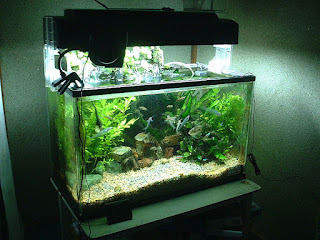

Tips & Advice when first setting up a tank…

Don’t add a bunch of fish all at once. There is a biological process (it slowly transpires) that has to take place, which involves healthy bacteria thriving within the tank, on random substrate, that helps break-down waste material. If you overload your tank before this naturalistic fundamental occurs, you will end up with toxic amounts of ammonia in the tank(s), which can be lethal to the fish. Remember, without good bacteria, your tank’s initial waste accumulates Ammonia, then when enough bacteria has cultured, the bacteria breaks the ammonia down to Nitrites (still harmful) and finally, into a less toxic Nitrate – which can be reabsorbed back into live plants, released into the atmosphere or removed manually by your filter replacements and water changes.

Don’t overfeed your fish; too much waste can build up and cloud the water. To rectify this (New Tank Syndrome), try adding scavengers and bottom feeders to your tank; they will feed off of the excess food and they add a nice touch to the tank.

If you don’t want to clean the glass with a magnetic brush, try adding some algae eaters. They will keep the glass surface spotless, as they regularly scavenge for microscopic growth, etc.

When first setting up your aquarium, after adding fish, ornaments, et cetera, you may notice the water becoming cloudy in a couple days. This is normal; let it clear on its own, naturally. This is simply a bacteria bloom and even though the nitrites may be high, it should taper down over the next several days into less harmful nitrates. But, during this crucial setup (as mentioned before), be careful not to overfeed or add too many fish. A crowded tank may look appealing, but it is not healthy for the inhabitants.

If this seems quaint or unfamiliar, I’d purchase a simple Beginners Guide/Book for aquariums and tropical fish. Once you get the basics, the rest is trial & error.

Closure…

This subject is so vast, it would require separate pages that specifically target certain aspects of Aquaria. If you have specific questions, there is a ‘comment field’ below.

This can be a very scenic, decorative piece to add to any residence or area.

Lastly, there is another, more complex aquatic hobby that requires more preciseness, that being Saltwater Aquariums.

But for beginners, I’d recommend freshwater fish for the meantime, and maybe eventually work your way up to the big boys – if desired.

Additional Reading Material:

A while back I started a Wildlife & Nature blog.  Recently, I just finished an aquatic series dedicated to freshwater aquariums, fish, plants, etc.   You can find that material in the February Archive, located here:  http://exotic-life-creatures.blogspot.com/2015_02_01_archive.html

—End of Part 1: “Freshwater Aquariums – A scenic, decorative hobby…"

Part 2: "New Tank Syndrome: Adding Healthy Bacteria to your Aquarium"

For the ones that are new to the aquarium hobby, you may inadvertently find out about an aquatic condition some people call "new tank syndrome." Unfortunately, it can be lethal to the more sensitive fish, but it can easily be avoided.

Anyway, when you first set up a fish tank, everything is obviously fresh. There is no waste, no fish, etc. Well, this also means that there are no bacteria present in the water (in most cases), as well. Not all bacteria is bad, and an established aquarium should always have an abundant supply of healthy bacteria, of course. Well, after you get all your primary components, gravel, air pump, water filters, etc., it is time to start adding some fish. When you start adding these little creatures and start feeding them, the waste will begin to accumulate. If you add too many fish early on and/or start overfeeding them, your ammonia levels can soar to unsafe levels. In due time, ammonia-eating bacteria will form and turn this into another harmful substance called Nitrite. Hopefully the nitrite will not hang around too long, and the nitrite-eating bacteria will soon appear. When they do show up, they will change the nitrite into a much safer nitrate. 

You can easily remove a lot of the nitrate that builds up by performing periodic water changes albeit most fish can handle high nitrate levels. Another way to naturally remove nitrate is to have live plants in the tank, as they will use the nitrates for nutrients and growth. Then, as you trim or remove the excess plant growth over time, you will also be removing the nitrates they absorbed during the process.

Outside of sheer neglect and ignorance, most of the premature deaths of aquarium fish happen early on, in a new tank, with a beginner hobbyist. Oh, I forgot to mention: Even if you do everything right and only add a small number of fish and feed sparingly, it is totally normal to have a cloudy tank in a couple days after first setting it up. Do not change the water when this happens, as this is called a "bacteria bloom." Yeah, the stuff you need. Eventually, the healthy bacteria will find various types of substrate and settle, colonize, and so on. A lot of the bacteria will thrive in the water filter housing and the water filter itself, along with the gravel and other objects in the tank. I'm not getting into vacuum pumps for gravel cleaning or the best types of filtration today, so let's move on.

Okay, so here is the main point of this post: If you are unsure and impatient when it comes to slowly building up your community fish tank, they do make a product just for you. Depicted above, is a product that contains live, healthy bacteria. It helps prevent ammonia and nitrite build-up and allows you to add more fish early on, without having to worry as much about the "new tank syndrome." This product comes highly recommended.  After your tank gets established, you shouldn't need to use this product anymore.

Anyway, I hope this post helps a few people that are just starting out in this aquatic hobby; cheers!


---End of Part 2

Image Credit: Fair Use - Amazon.com - Product Image is found on various websites and catalogs throughout the globe.

---End of Post "New Tank Syndrome: Adding Healthy Bacteria to your Aquarium"

Saturday, February 14, 2015

Livebearers - Aquarium Fish

Without going into detail, livebearers (also known as live-bearing aquarium fish) don't lay eggs like most fish, as they actually have some penile insertion going on, also known as sexual intercourse. These can be some of the cheapest, most colorful fish you may ever acquire for your freshwater aquarium. I say that because many times you will just need one male and a female or two of each livebearer species, and the next thing you know, you'll have an entire tank full of tropical bliss.

Most livebearers have one distinct habit that makes them seem rather ferocious when compared to the rest of the common aquarium fish, as they have the tendency to eat their own young. Yikes! Anyway, if a person had the supplies, the space and the public demand for such things, you could make a living selling these things with no problem at all. Yeah, but it don't generally work that way anymore. For one, most people will prefer a wide variety of fish (mostly egg layers - which are harder to breed in captivity) and, with the fish business, the losses and liabilities often pack a big wallop against the total profits, to say the least. But forget the business side of it for now, as we are talking about aquarium fish for the hobbyist.

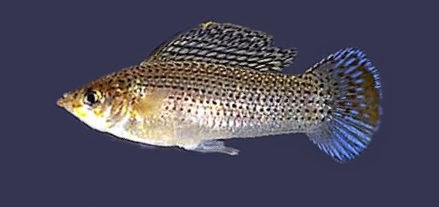
Livebearers are an excellent fish for the beginner. The most popular livebearer I can think of, is the Guppy. 2nd on the list would be the Platies/Platys. Coming in at a close 3rd would be the Swordtails and the Mollies would bring up the rear at number 4, in my opinion, as the most popular livebearers in freshwater aquariums. Depicted above, will be those very fish I just mentioned in that order. They come in all types of different colors, which is another reason they are so cool to breed.  You will get to see all the different colors mix and match from generation to generation.

I once knew a guy that kept a turtle in his tank, and he had so many livebearers in there that he never had to feed the turtle. The turtle would keep the population in check and they would reproduce at about the same rate they got consumed; ha!

Image Credit: Public Domain & Wikimedia Commons. Source = Wikipedia

---End of Post "Livebearers - Aquarium Fish"