Disclaimer: This blog may contain affiliate links. I may receive a commission if you click a link and purchase something within this site. As an Amazon Associate I earn from qualifying purchases.

Monday, February 9, 2015

Tire Track Eel


This little eel is native to India, Sri Lanka, Thailand, Indonesia and a few other countries in that area. I first became aware of this cool creature when I was involved with the aquarium hobby. I only had one "tire track eel," but it didn't work out too well. I had that particular tank packed with aggressive eaters and the bottom-dwellers and scavengers took care of the lower section, as well. That type of scenario was especially bad for them, since these types of eels like to dwell close to the bottom and even burrow into the gravel, at times. Basically, I should have never bought the Tire Track Eel, but they are hard to turn down when you have fish tanks. I'm assuming they do well in less competitive tanks...

I would explain how they got their name, but their appearance should be self-explanatory. You know, like it has tire tracks imprinted on it? LOL! Anyway, they are nocturnal for the most part, and they do prefer live foods, going by what I've read.  Going by what little I have seen of them, they definitely seem shy and/or timid. Since they do prefer darkness, it is sort of pointless to have them in a community fish tank. When it comes to common fish foods that a person would typically use for home aquariums, they also seem to be picky eaters. However, if you have a tank with a bunch of tiny fish in it (like the small livebearers known as guppies), I've heard that they will come out and eat them at night; ha! Other than that, I don't really know very much about this eel. I just think they look cool, so I posted it here; cheers!

Update: A few years after I posted this, it seems that the Internet has shifted into calling these little aquatic creatures "Zig-Zag Eels." Uh, okay, I guess... I even changed the Wikipedia link below to reflect that name change. I mean, these eels are also still called "Tire Track," just saying that now it seems their primary, most commonly used name is "Zig Zag."  I guess it doesn't really make a difference because it's just silly semantics. It is what it is, as they say... 
---End of Update

Image Credit: Using the Google Image search with the 'free to use & share' function. The 2nd pic is from Wikimedia Commons. Source = Zig-zag eel - Wikipedia

---End of Post "Tire Track Eel"

Thursday, January 8, 2015

Carnivorous Plant - Venus Flytrap

This is such a cool, carnivorous plant. I haven't owned one in over 10 years, but I've recently been thinking about buying some. In the past, I got on this kick where I would collect exotic plants, succulents, cacti, bamboo stalks, etc. By what I recall, I didn't have my Venus Flytrap for very long because I was too busy to care for it and/or it died for whatever reason.

Anyway, I think they still sell those carnivorous plant kits, so I may check them out pretty soon. They are generally slow-growing plants and actually require poor soil conditions - which is the opposite of what I'm used to. How many plants require poor soil besides a cactus? Well, evidently several plants do, and these are no exception. There are many other types of carnivorous plants, but I always liked the way this one looked. The traps catch bugs, flies, etc., and closes on 'em while it then begins to literally consume them. In nature, this type of feeding would compensate for the poor soil conditions. Pretty neat, eh?

Since I don't plan on allowing bugs and flies into my home (What's next? Indoor pet snakes; ha!), it could become a chore to feed these plants. I'm assuming they would still thrive with proper care, but this is one of the main reasons I haven't bought any more of these. They can be difficult to grow, and you need to try and replicate their natural surroundings as much as possible. They are only native to North and South Carolina, in the United States. I guess, perhaps, maybe that is where they should stay. However, if you have any luck with growing these indoors, feel free to drop down some of your tips in the comment field below. I feel like these plants require something else besides a green thumb; ha! 

Anyway, I just thought this was a cool plant, so I decided to share these tidbits today; cheers!

Related Post: http://exotic-life-creatures.blogspot.com/2015/01/eyeball-plant-dolls-eyes.html

Image Credit: Wikimedia Commons. It was originally an animated image, but I altered it with my Paint Program. Source = en.wikipedia.org/wiki/Venus_Flytrap

---End of Post "Carnivorous Plant - Venus Flytrap"

Eyeball Plant - Doll's Eyes

Well, this wildlife & nature blog has pretty much contained posts that have been strictly related to non-plant specimens albeit that is about to change as the subjects become more diverse along the way...

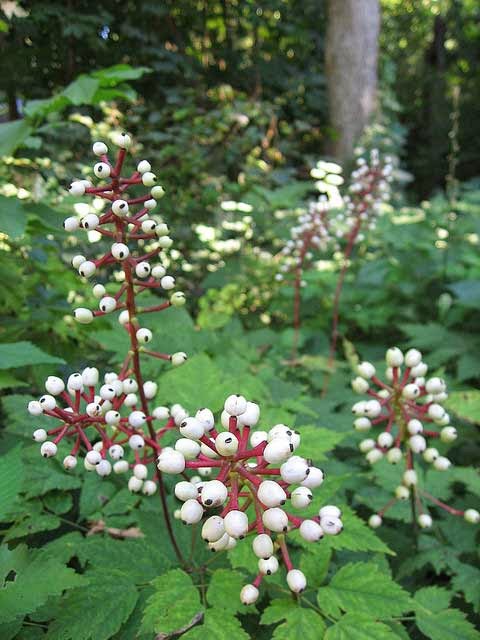
What a weird plant, eh? I found this bizarre vegetation when doing an online search about Halloween plants, spooky plants, and so on, several months ago. I was just in the mood for some freaky foliage during that time, and I ended up running into several different types that I never seen before. For this post, I decided to go with the one called "Doll's Eyes." This eyeball plant is a perennial that usually grows a couple feet tall and 3 feet wide.

When looking at this plant, what appears to be eyeballs is actually its fruit/berries. These things ripen during the summer and they last until frost hits.
The Doll's Eyes are poisonous to humans, though, as the eyeball and the plant itself is not for our consumption by any means. I don't know why you would think the eyeball plant looks like something to eat anyway, but if you were to ingest it, you could end up having a heart attack and die - since this type of poison supposed to affect your heart muscle, as well. Yeah, if you did grab a handful of these rudely staring berries and shove them into your mouth, I guess the plant would then simply lay back and "watch" you die as an end result? Now wouldn't that be creepy in a nefarious way? Ha!

Now, on the other hand, if you were a bird, you could peck the eyes right out, as they are immune to this particular plant. Birds are cool like that since they are one of nature's best seed spreaders. They do the same thing with hot peppers, for example. When it comes to being immune to harsh edibles and spreading seeds, birds are impeccable albeit they sure peck a whole hell of a lot; ha! Well, I just thought I'd share these tidbits with you all since this is not a common plant that you see every day, well, unless it grows close to where you live, of course. If I did live at a place that was covered in these plants, I'm not exactly sure what I would do.  I really like scenic trees, shrubs, and foliage, but I don't really like things with uninhibited staring problems, either. Hmm...  Such a biological quagmire at hand...

Image Credit: en.wikipedia.org/wiki/Actaea_pachypoda

---End of Post "Eyeball Plant - Doll's Eyes"

Stick Insect


Well, since it seems that there has been a recent stick-man/stick-figure drawing movement/fetish going on here of late while visiting various websites online, I thought that the least I could do was provide an image and a brief summary of the stick insect via Mother Nature. At any rate, many folks call these little creatures "walking sticks," but I didn't want to confuse this insect with a walking cane, so the term stick-insect should suffice. This little insect is one of the many marvels of nature. It resembles a small stick or twig while being exquisitely camouflaged in its natural surroundings and it enjoys this life of concealment to the fullest.

I remember first seeing these stick insects as a kid, and they were very hard to spot. Even after seeing what appeared to be a walking twig, it still took a few seconds for my eyes to adjust to what I was witnessing. Then, after a few shakes of the head, it was like "that stick is alive!" Ha-ha! These creatures are all slender and elongated. There are differences in detail and color between the species of this insect and, sometimes, even between the specimens of the same species. The majority of them reproduce without the need for a male and/or any effort on their part. This is a good thing because most stick insects are female anyway, going by what I have read in the past. They are easily kept and are excellent laboratory insects if you like studying them because of their style of reproduction. I've even heard that some people like to keep them as pets, too.

So if you're out in nature and are about to build a campfire, be careful when you are gathering kindling and small twigs or whatever.  As you may accidentally throw one of these little bastards into the fire; ha! Just kidding... I mean seriously, they are not that common or at least not in my neck of the woods.  Wait a minute, maybe they are and I just never notice them because I never wait for the little twigs to start walking off...  Oops!

Image Credit: funkman.org/animal/insect/stickinsect.html [Link is no longer valid]

Related Link:  http://exotic-life-creatures.blogspot.com/2015/01/praying-mantis-insect.html

---End of Post "Stick Insect"

Dog-Face Puffer Fish

I was watching an aquarium show last night and seen a really cool-looking fish for saltwater aquariums. All the years I had fish tanks, I strictly dealt with tropical fish and freshwater conditions, as marine tanks require much more room and, most of all, way more money! Anyway, I've written several aquarium-related posts on here, and I'll link to a few of them (too many to list all of them) in a moment.

At any aquatic rate, the dog-face puffer fish (also called the Blackspotted puffer) is really neat. Their face resembles that of a dog; ha! Seriously, it is so weird when you see them up close. It looks like a canine swimming underwater with most of its body chopped off. The dog-face puffer fish lacks pelvic fins, but it still gets around pretty good while using its dorsal, pectoral, and anal fins. The people on the show were talking about how great their personality is and how they really pay attention to their owners, unlike most pet fish (except for maybe Oscars & African Cichlids). Hey, there again, it sounds like a dog!

So, with that being said, if you have the room and the money for a saltwater setup, the dog-face puffer fish would be a great addition to your home. Like any aquarium fish, though, you need to educate yourself about each species before mixing them with others. Since I'm only knowledgeable about freshwater aquariums, I can't help ya with this one; cheers!

Image Credit: Wikimedia Commons - Source = en.wikipedia.org/wiki/Blackspotted_puffer

Side Note: Oh, yeah. I almost forgot to link to those aquarium-related posts I was talking about at the beginning of this post. Instead of linking to each one, I wrote most of them in February, so I'll just link to that particular part of the archive.  I'll call it "Aquarium Fish, Plants, and Food."

---End of Post "Dog-Face Puffer Fish"

Wednesday, January 7, 2015

Living Fossil: Prehistoric Pignose Frog


Most people refer to this amphibian as the "Purple Frog," but it doesn't look very purple to me. It is also labelled as the Pignose Frog, so we'll go with that, for this post. Anyway, many folks conclude that this prehistoric frog is, in fact, a living fossil. It is another one of those strange creatures that throws a giant "WTF" to the evolutionists out there. The pignose frog is supposed to be split up from other frogs somewhere around 150 million years ago, and it has obviously not changed very much since! It was finally discovered to still be living in today's world, back in 2003 albeit the tadpole version was described in 1918, going by what I've read.

These ancient "purple frogs" spend 50 weeks per year buried underground, which only gives them about 2 weeks above the surface during any given year. Wow! No wonder these suckers have been hard to find! However, these weird-looking frogs are on the endangered species list. I don't really know how they can keep an accurate count of the pignose frogs, especially since they've been hiding from us for so long. Either way, I thought I'd share this prehistoric amphibian today, that supposedly comes from a family of frogs that were here during the dinosaur days; cheers!

Image Credit: Wikimedia Commons. Source = en.wikipedia.org/wiki/Purple_frog

---End of Post "Living Fossil: Prehistoric Pignose Frog"

Update: I'm about to provide an excerpt from Wikipedia that they added a few years after this post. It helps clear up some confusion about the history of this frog's discovery. I've already provided a link to this excerpt via the image credit. 

"The species was described from specimens collected in the Idukki district of Kerala by S.D. Biju from the Tropical Botanic Garden and Research Institute in Palode, India, and Franky Bossuyt from the Vrije Universiteit Brussel (Free University of Brussels), in 2003. However, it was already well known to the local people and several earlier documented specimens and publications had been ignored by the authors in the 2003 paper that describes the genus and species."

Well, in a thumbnail, I guess that means that in 2003 many folks acted like it was recently discovered, but all the locals in that area were like, "Duh! This pignose frog thingy has been hanging with us for a long time, bro!" Ha-ha! Anyway, I just thought I'd drop that tidbit off. I must say, though, it is interesting when researching living fossils - especially when you find out they haven't changed much, if at all, from prehistoric records and/or fossils, etc.  ---End of Update

Dumb & Crazy Dodo Bird

Well, times must be really tight if I'm on here writing about dumb birds called a Dodo. Hell, they have been extinct for a long while and the primary knowledge we have about them is from written accounts and artwork that depicts these crazy creatures. Anyway, I have no idea why I'm scribbling this nonsense down, but it has been a morning full of poppycock, so why not add some over-sized pigeon that can't even fly, into the mix. Ha!

The Dodo Bird supposedly stood about 3 feet 3 inches tall. Why they feel the need to add those extra 3 inches to the data pool, beats me. I mean, why not just say that the stupid thing was about 3 feet tall? LOL! The weight of this bird supposed to vary, like most living things, and I've heard of a range from 20 to 40 pounds all the way up to 44lbs., in the past. This sorry excuse for a bird was reported to have brownish and grayish feathers. Some people like to sound more scientific and call the feathers plumage, but the Dodo bird doesn't care either way.

This borderline brainless bird was rather fat and had little wings, hence forth the notion that it wasn't very aerodynamic nor could it fly. Good job, birdie! On the isolated island of Mauritius, in 1598, a Dutch admiral described this bird that he called "walghvogel." Later on, some of the Dutch settlers called it "dodaars." Portuguese sailors called the silly thing "doudo," which means "fool" or "crazy." See? Even they thought the Dodo was asinine. I'm not sure when it went extinct, as I've heard different answers for that, but it was gone before the 18th century ever got here, nonetheless. Of course, man was the main cause for its extinction, one way or another. I think their introduction to certain animals in that region also helped speed up the process.

Side Note: I really don't have anything against the Dodo bird. I was just trying to make light of a dead bird that couldn't fly; ha!

Image Credit: It's in the Public Domain and is not under copyright protection. Source = en.wikipedia.org/wiki/Dodo

Related Post: http://exotic-life-creatures.blogspot.com/2015/01/woodcock-bird.html

---End of Post "Dumb & Crazy Dodo Bird"

Tuesday, January 6, 2015

Tuatara - Reptile

This is a rather unique creature and is considered to be a "living fossil." A popular/famous example of a living fossil is the coelacanth fish. Anyway, it looks like a lizard but is actually quite different. Scientists say that the tuatara’s closest relatives are an extinct group of reptiles that lived close to the time of the dinosaurs. Male tuataras are larger than the females.

Here are some examples of how this unusual creature differs from a typical lizard: They like cooler conditions while lizards like warm weather. Unlike lizards, they have no external ears. The tuataras have a 3rd eye on top of its head although it is not used for seeing. The bizarre third eye is sensitive to light and maybe it helps the creature better gauge the time of day, but who knows? The mystery eye has the nerve endings, retina and lens, but it is covered with scales. That is so odd. I mean, I've heard it stated in the study of metaphysics how humans have a metaphorical 3rd eye called the pineal gland because it acts like your sixth sense, but for this particular reptile it literally has one - although it's mostly covered up with scales.

Here are a couple extra tidbits about the tuatara: I've recently read that they have the lowest metabolism of any reptile. Dang, that is saying a lot! When tuatara eggs get too cold, their development stops until it gets warmer again. Hmm, under bad situations, that egg is going to be waiting a long while to hatch. Anyway, I thought I'd share this interesting creature with the community here, today; cheers!

Image Credit: This is a file from the Wikimedia Commons. Source = en.wikipedia.org/wiki/Tuatara

---End of Post "Tuatara - Reptile"

Monday, January 5, 2015

The Bizarre Bombardier Beetle

I recently mentioned a beetle that could basically blow fire out of its bunghole, on another community website, a while back. Since some folks may have thought that I was simply nuts or insane, I thought it would be a good idea to clarify on my Wildlife & Nature Blog; ha!

Bombardier beetles are ground-based beetles that come equipped with a bizarre defense mechanism that, when bothered or pissed off, allows them to eject an extremely hot, vapor-like chemical spray out from the tip of their abdomen. Oh, it makes a popping sound, too. LOL!

This spray is due to a chemical reaction between hydrogen peroxide and hydroquinone, which is stored in separate areas of the abdomen. This creative beetle has a 3rd chamber that mixes this stuff with catalytic enzymes and water. This crazed reaction not only produces the gas that fuels the ejection, but it also heats up to nearly the boiling point of water during the process. Any poor insect or tiny critters that get near this beetle's butt, is just asking for death!

If you'd like a more elaborate explanation, go here: en.wikipedia.org/wiki/Bombardier_beetle

Some people also use this beetle to defend the myths & legends of ancient fire-breathing dragons, too. I assume they think that a similar mechanism could exist in a dragon's throat much like what is found on this beetle's backside? Hmm, now that's an interesting thought when brought to full scale! Of course, this bug also makes for great debates when concerning certain aspects of the theory of evolution. If you'd rather read more about that, you can start here: https://answersingenesis.org/evidence-for-creation/design-in-nature/pygidial-gland-of-the-bombardier-beetle-brachinus-sp/

Anyway, I just thought I'd share these interesting tidbits with the community today; cheers!

Image Credit: Is already provided in the Wiki link above.

---End of Post "The Bizarre Bombardier Beetle"

Jurassic Frog vs. Goliath Frog

This is such an odd subject, but either way, nobody seems to know very much about the Jurassic Frog. Naturally, we would like to think that everything was bigger back during the Dino Days, but going by what I have read, the poor old frog hasn't changed a whole lot. I just read on some frog-guru website that they first appeared during the late Jurassic period, somewhere around 190 million years ago or +/- a few gazillion years; ha-ha! They later went on to mention that the fossils demonstrate that the skeletal shape and body of these Jurassic frogs has basically remained unchanged over the last 190 million years.

Wow! I'm not happy about this. So, I went and did a quick search for the almighty Goliath Frog in Africa, and that sucker is still alive. Well, it is endangered, but still hopping at the moment. They are the largest known frogs in the world and certain ones can grow up to 13 inches in length and weigh up to 7 pounds. Holy crap! For the ones that eat frog legs, can you imagine the drumsticks on that sucker? It would be like eating the legs off of an oversized hen; ha! Anyway, its numbers are dwindling due to the usual reasons: habitat destruction, humanoid consumption, and due to them being a part of the pet trade market, as well. Hmm... I think I said the same thing on that post about the Philippine Tarsier a while back.

Now back to the original subject... Who would win today if they could both meet? The Jurassic Frog or the pissed-off Goliath Frog that is slowly going extinct because people can't find anything else better to eat than frogs? I wonder how a hungry Homo sapien would react to a gigantic 8-foot frog with a 5 ft. tongue, if there was such a thing? Ha!

Image Credit: en.wikipedia.org/wiki/Goliath_frog

---End of Post "Jurassic Frog vs. Goliath Frog"

Related Post:  Prehistoric Purple Frog / Pignose Frog