...As intelligent as man?
It is clearly quite unnecessary to offer an introduction to the popular dolphin for it has conquered the hearts of many, throughout the world. This extraordinary legless sea mammal has held the high esteem of fishermen for centuries - who give it their respect as a consequence of its friendly attitude towards man. Hell, I have though many times that dolphins may actually be on a higher level of existence than us in a spiritual sense, but regardless of such matters, they often seem more intelligent than the majority of humans on this planet, at least by what I have seen. Anyway...
The bottlenose dolphin moves in the water with an ease which makes it the envy of all others - the fish which are its prey, in particular. This creature has a huge appetite and spends a considerable amount of time hunting beneath the surface in order to satisfy its needs. The bottlenose dolphin is a very sociable animal and lives in groups, usually between 10 and 20 dolphins on average.
As many of us know, with it being blessed with a happy disposition, the dolphin plays a lot and nothing is more exciting for an aquatic life lover than to watch its antics as it leaps, twists, turns, dives and races along. The special texture of a dolphin's skin enables it to swim at incredible speed since it offers minimum resistance to the water. It propels itself by vertical movements of the tail which is itself merely a modification of the mammalian tail.
The bottlenose dolphin is one of the most loquacious animals in the ocean: the members of a group speak to each other ceaselessly by means of a complicated language of cries and whistles. The dolphin also navigates by sonar - emitting very high-pitched cries which echo back when they strike an obstruction, also known as "echolocation." Per Wikipedia: "Echolocation, also called bio sonar, is the biological sonar used by several kinds of animals. Echolocating animals emit calls out to the environment and listen to the echoes of those calls that return from various objects near them. They use these echoes to locate and identify the objects. Echolocation is used for navigation and for foraging (or hunting) in various environments."
It is thought that the special bump located on the front of its head is a receptor organ.
Many people, including experts, consider that with its enormous brain, the dolphin is probably the most intelligent of all mammals, after man. Like I said before, it seems to me that they have more intelligence than the majority of mankind albeit there are different types of intelligence, so it is hard to put a set model out there to use in comparison. Basically, what I'm trying to say, is that a person could be really slow and dumb in most things but be a genius in certain things. With the diversity of life on this planet within this grand cosmos, there is no IQ test out there that can accurately measure the limits of intelligent beings, no matter how ya slice it! But, I'll wait until they can upload our consciousness into a computer before I can say for sure; ha!
I could type so much about this friendly mammal, but I guess I'll stop right here. There are so many stories about how dolphins have saved the lives of humans, killed mean sharks, etc., that it would take a long while just to talk about that. Anyway, praise be the dolphins!
Related Links:
* Bottlenose Dolphin Facts and Pictures -- National Geographic Kids (Link is no longer active)
* Bottlenose dolphin - Wikipedia, the free encyclopedia
Semi-Related Blog Link: "We need to keep the Shark Population thriving..."
Shopping Link via Amazon for Dolphin-Related Products, Posters, etc. (Link is no longer active)
---End of Post "Intelligent Bottlenose Dolphin"
A Blog about different types of living beings ranging from exotic animals & interesting creatures to rare insects, naughty reptiles and large mammals, etc. - along with anything else that relates to nature, gardening...
Disclaimer: This blog may contain affiliate links. I may receive a commission if you click a link and purchase something within this site. As an Amazon Associate I earn from qualifying purchases.
Friday, June 21, 2013
Thursday, June 20, 2013
Hermit Crab
Lives in a portable home...
If you go out to the rocks exposed at low tide and look into one of the pools, you may see something puzzling: a shell apparently scuttling along the bottom under its own steam! On closer inspection you will see that the shell has long, jointed legs. It is in fact a crab with a shell on its back - a hermit crab.
Hermit Crabs have soft abdomens, unprotected by a carapace. The shells they live in, which may be straight or coiled, are an excellent substitute for this tough covering. The right pincer claw is always larger than the left and is used not only for capturing food but also for blocking the entrance to the shell. There are a great number of different species of hermit crab, the biggest being the famous coconut or robber crab (really a hermit crab which has given up living inside shells because it cannot find any big enough; ha!) that has developed an extra tough carapace to compensate for the lack of shell.
Hermit crabs start searching for a shell of suitable size very early in life. Once inside, no amount of prodding will induce a hermit crab to come out against its will. Growth takes place in a series of molts and the bigger crab must look for a roomier shell. Hermit crabs depend for their survival on the gastropod mollusks - whose shells they appropriate.
A hermit crab changes shells very quickly, so that it is exposed and defenseless for only a very short amount of time (yeah, I'd be in a hurry, too!). It finds a new shell before leaving the old one, of course, as that would be really risky to just drop your shell and wander around aimlessly, wouldn't ya say? After carefully inspecting a potential new shell with its pincers to make sure it is acceptable, it sidles smartly into the new shelter/shell.
As pets, several marine species of hermit crabs are common in the marine aquarium trade. Personally, I prefer the decorative, scenic hobby of freshwater aquariums, but anyway... Of the approximately 15 terrestrial species in the world, the following are commonly kept as pets: Caribbean hermit crab, Australian land hermit crab, and the Ecuadorian hermit crab. Other species are less common but growing in availability & popularity as pets. These omnivorous or herbivorous species can be useful in the household aquarium as scavengers because they eat algae and debris. Hermit crabs are often seen as a "throwaway pet" that would live only a few months, but species such as the Caribbean hermit crab (Purple Pincher or PP) have a 23-year lifespan if properly treated, and some have lived longer than 32 years.
Image Credit: http://en.wikipedia.org/wiki/File:Calliactis_and_Dardanus_001.JPG
---End of Post "Hermit Crab"
If you go out to the rocks exposed at low tide and look into one of the pools, you may see something puzzling: a shell apparently scuttling along the bottom under its own steam! On closer inspection you will see that the shell has long, jointed legs. It is in fact a crab with a shell on its back - a hermit crab.
Hermit Crabs have soft abdomens, unprotected by a carapace. The shells they live in, which may be straight or coiled, are an excellent substitute for this tough covering. The right pincer claw is always larger than the left and is used not only for capturing food but also for blocking the entrance to the shell. There are a great number of different species of hermit crab, the biggest being the famous coconut or robber crab (really a hermit crab which has given up living inside shells because it cannot find any big enough; ha!) that has developed an extra tough carapace to compensate for the lack of shell.
Hermit crabs start searching for a shell of suitable size very early in life. Once inside, no amount of prodding will induce a hermit crab to come out against its will. Growth takes place in a series of molts and the bigger crab must look for a roomier shell. Hermit crabs depend for their survival on the gastropod mollusks - whose shells they appropriate.
A hermit crab changes shells very quickly, so that it is exposed and defenseless for only a very short amount of time (yeah, I'd be in a hurry, too!). It finds a new shell before leaving the old one, of course, as that would be really risky to just drop your shell and wander around aimlessly, wouldn't ya say? After carefully inspecting a potential new shell with its pincers to make sure it is acceptable, it sidles smartly into the new shelter/shell.
As pets, several marine species of hermit crabs are common in the marine aquarium trade. Personally, I prefer the decorative, scenic hobby of freshwater aquariums, but anyway... Of the approximately 15 terrestrial species in the world, the following are commonly kept as pets: Caribbean hermit crab, Australian land hermit crab, and the Ecuadorian hermit crab. Other species are less common but growing in availability & popularity as pets. These omnivorous or herbivorous species can be useful in the household aquarium as scavengers because they eat algae and debris. Hermit crabs are often seen as a "throwaway pet" that would live only a few months, but species such as the Caribbean hermit crab (Purple Pincher or PP) have a 23-year lifespan if properly treated, and some have lived longer than 32 years.
Image Credit: http://en.wikipedia.org/wiki/File:Calliactis_and_Dardanus_001.JPG
---End of Post "Hermit Crab"
Roller Bird
Its brilliant plumage brings an exotic note to the countryside...
The rollers are an Old World family, Coraciidae, of near passerine birds. The group gets its name from the aerial acrobatics some of these birds perform during courtship or territorial flights. Roller birds resemble crows in size and build, and share the colorful appearance of kingfishers and bee-eaters - blues and pinkish or cinnamon browns predominating. The two inner front toes are connected, but not the outer one.
The roller is a very beautiful bird, which some ornithologists claim is the most beautiful of all European birds. It is a solitary bird, quite difficult to observe since it is not very common. Despite its brightly colored feathers, it can easily hide itself among the foliage and its discreet way of life enables it to remain largely unseen. It is also a migratory bird.
The roller bird provides our fauna with an exotic element and its coloring will give any nature lover a distinct shock when first seen. To see it perched, with its rather angular appearance, it is hard to believe that it is a real acrobat in the air. It can climb vertically and then drop like a stone with wings closed until it is close to the ground. The rare spectacle of a pair of roller birds in mating display is unforgettable. Sometimes, several couples gather to parade together but this phenomenon hardly ever occurs in Northern countries, where the bird is rare and exists only in isolated specimens.
The roller's diet is varied but consists principally of all kinds of insects, which it snatches in flight with the adroitness of a bee-eater. The nest site is usually in a cavity that either formed naturally in a tree or from a hole that was pre-drilled by a woodpecker. Below, is an example of one the specimens from the roller family:
Image Credit: http://en.wikipedia.org/wiki/File:Lilac-breasted_roller.jpg
The rollers are an Old World family, Coraciidae, of near passerine birds. The group gets its name from the aerial acrobatics some of these birds perform during courtship or territorial flights. Roller birds resemble crows in size and build, and share the colorful appearance of kingfishers and bee-eaters - blues and pinkish or cinnamon browns predominating. The two inner front toes are connected, but not the outer one.
The roller is a very beautiful bird, which some ornithologists claim is the most beautiful of all European birds. It is a solitary bird, quite difficult to observe since it is not very common. Despite its brightly colored feathers, it can easily hide itself among the foliage and its discreet way of life enables it to remain largely unseen. It is also a migratory bird.
The roller bird provides our fauna with an exotic element and its coloring will give any nature lover a distinct shock when first seen. To see it perched, with its rather angular appearance, it is hard to believe that it is a real acrobat in the air. It can climb vertically and then drop like a stone with wings closed until it is close to the ground. The rare spectacle of a pair of roller birds in mating display is unforgettable. Sometimes, several couples gather to parade together but this phenomenon hardly ever occurs in Northern countries, where the bird is rare and exists only in isolated specimens.
The roller's diet is varied but consists principally of all kinds of insects, which it snatches in flight with the adroitness of a bee-eater. The nest site is usually in a cavity that either formed naturally in a tree or from a hole that was pre-drilled by a woodpecker. Below, is an example of one the specimens from the roller family:
Image Credit: http://en.wikipedia.org/wiki/File:Lilac-breasted_roller.jpg
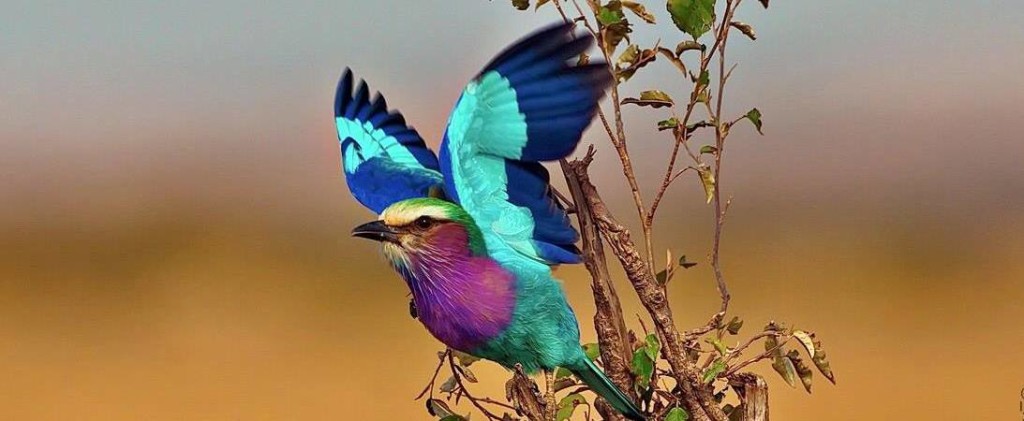
This next image is a more brilliant photo of a Lilac Breasted Roller:
Yeah, that bird is definitely styling and profiling. Ha!
Image Credit: Lilac Breasted Roller - Most Beautiful Bird in The World - Charismatic Planet [https://www.charismaticplanet.com/lilac-breasted-roller/] By the way, this last image credit appears to be linking to a high-quality website. I may need to re-visit that place when I get a chance because they seem to have loads of interesting content that is not limited to one particular genre. When I checked the image source originally, I was expecting a Nature & Wildlife blog, but diversity is always a good thing, for sure.)
---End of Post "Roller Bird"
Saturday, June 8, 2013
Green Basilisk
Unworthy king...
Provided with a crest that looks like a crown, the basilisk owes its name to a Greek word (basiliskos) meaning "little king." In European bestiaries and legends, a basilisk is a legendary reptile reputed to be king of serpents and said to have the power to cause death with a single glance.
...But the green basilisk does not deserve the majesty of kingship, since it is one of the most timid of creatures. When this iguana lizard is frightened by an intruder, it becomes a thunderbolt and plunges into the water or, amazingly, runs across the surface, as its great agility and speed make it possible for the basilisk to do this without sinking - which is why you will sometimes hear it referred to as the Jesus Christ lizard, you know, "walk on water;" ha-ha!
Speaking of the bible, it is mentioned in there a few times. One example is in Isaiah 14:29 in the prophet's exhortation to the Philistines reading, "Do not rejoice, whole country of Philistia, because the rod that beat you has broken, since the serpent's stock can still produce a basilisk, and the offspring of that will be a flying dragon." The King James version of the Bible states "out of the serpent's root shall come forth a cockatrice, and his fruit shall be a fiery flying serpent."
Anyway, there are several species of basilisk, all of which live in tropical America as its natural range covers a swath from Mexico to Ecuador. They are distinguished by the color of their scales and the more or less rounded shape of the crest. A daytime animal, the basilisk always lives in waterside shrubs and trees. It has a habit of curling its tail when at rest, for whatever reason. Green basilisks are omnivorous and eat insects, small mammals, smaller types of lizards, fruits and flowers. Their predators include birds of prey, snakes and opossums.
After mating, the female digs a hole about 3 inches deep, at the bottom of which the eggs (about 10 to 20 on average) are laid. The hole is then covered. The young hatch and come to the surface about 2.5 to 3 months later. The males are very territorial when it comes to females and mating, but this is nothing new.
Depicted below, is a green basilisk:
---Image Source: http://en.wikipedia.org/wiki/File:Plumedbasiliskcele4_edit.jpg
These lizards grow to 2 feet long on average, but can reach lengths of 3 feet, albeit most of the length is due to the long tail.
---End of Post "Green Basilisk"
Provided with a crest that looks like a crown, the basilisk owes its name to a Greek word (basiliskos) meaning "little king." In European bestiaries and legends, a basilisk is a legendary reptile reputed to be king of serpents and said to have the power to cause death with a single glance.
...But the green basilisk does not deserve the majesty of kingship, since it is one of the most timid of creatures. When this iguana lizard is frightened by an intruder, it becomes a thunderbolt and plunges into the water or, amazingly, runs across the surface, as its great agility and speed make it possible for the basilisk to do this without sinking - which is why you will sometimes hear it referred to as the Jesus Christ lizard, you know, "walk on water;" ha-ha!
Speaking of the bible, it is mentioned in there a few times. One example is in Isaiah 14:29 in the prophet's exhortation to the Philistines reading, "Do not rejoice, whole country of Philistia, because the rod that beat you has broken, since the serpent's stock can still produce a basilisk, and the offspring of that will be a flying dragon." The King James version of the Bible states "out of the serpent's root shall come forth a cockatrice, and his fruit shall be a fiery flying serpent."
Anyway, there are several species of basilisk, all of which live in tropical America as its natural range covers a swath from Mexico to Ecuador. They are distinguished by the color of their scales and the more or less rounded shape of the crest. A daytime animal, the basilisk always lives in waterside shrubs and trees. It has a habit of curling its tail when at rest, for whatever reason. Green basilisks are omnivorous and eat insects, small mammals, smaller types of lizards, fruits and flowers. Their predators include birds of prey, snakes and opossums.
After mating, the female digs a hole about 3 inches deep, at the bottom of which the eggs (about 10 to 20 on average) are laid. The hole is then covered. The young hatch and come to the surface about 2.5 to 3 months later. The males are very territorial when it comes to females and mating, but this is nothing new.
Depicted below, is a green basilisk:
---Image Source: http://en.wikipedia.org/wiki/File:Plumedbasiliskcele4_edit.jpg
These lizards grow to 2 feet long on average, but can reach lengths of 3 feet, albeit most of the length is due to the long tail.
---End of Post "Green Basilisk"
Ring-tailed Lemur
Always walks with its tail in the air...
The ring-tailed lemur (more exotically known as "maki catta") is one of the most fascinating lemurs on the island of Madagascar. Unlike its fellow lemurs, the ring-tailed lemur has partially abandoned a tree-dwelling existence for a terrestrial one - preferring to stay on the ground and walk around with its long tail permanently held erect like a staff. These attractive creatures are diurnal and love to bask in the sun whenever possible.
A group of ring-tailed lemurs, with their wonderful black & white tails, is not a sight one quickly forgets. They are sociable animals, living in groups of 15 to 20 individuals on average, and are very energetic - rarely still during the day. They are very inquisitive, as well, and examine everything they encounter during their travels (sounds about as curious as a cat).
Being primarily vegetarians, they eat the fruit, flowers, buds and leaves of certain trees. However, they also catch lizards and insects when they can and eat 'em while sitting on their rumps with their tails vertical against their backs. This little critter is also very skillful with its hands, like most monkeys. They are just as agile in the trees as on the ground, jumping gaps several yards wide between one branch to another while moving with such speed that it's difficult to keep pace with them in the forest undergrowth.
As one of the most vocal primates, the ring-tailed lemur uses numerous vocalizations including group cohesion and alarm calls. Experiments have shown that the ring-tailed lemur, despite the lack of a large brain, can organize sequences, understand basic arithmetic operations and preferentially select tools based on functional qualities.
The ring-tailed lemur, being very timid, scares easily. When frightened, they immediately dash up a tree for safety. From there, they will watch the object of their fear from high up in the tree. I have read before about an unusual method they use to resolve conflicts during mating season. In less words, you could call it a "stink fight." Ha! Anyway, the males have scent glands on their shoulders and wrists. They produce a short-lived odor from their wrist area and a longer lasting one from the shoulder region. They sort of fan their tails, when threatened by other male lemurs, to send an unfriendly stench towards their potential enemies. I assume this goes back and forth until somebody gives up from the smell and the winner is whoever smells the worst? Anyway, to change the subject...
---------Image Credit: http://www.bbc.co.uk/nature/life/Lemuridae (link is no longer active)
Related Link: "Images of the freaky Lemur - Aye-Aye"
---End of Post "Ring-tailed Lemur"
The ring-tailed lemur (more exotically known as "maki catta") is one of the most fascinating lemurs on the island of Madagascar. Unlike its fellow lemurs, the ring-tailed lemur has partially abandoned a tree-dwelling existence for a terrestrial one - preferring to stay on the ground and walk around with its long tail permanently held erect like a staff. These attractive creatures are diurnal and love to bask in the sun whenever possible.
A group of ring-tailed lemurs, with their wonderful black & white tails, is not a sight one quickly forgets. They are sociable animals, living in groups of 15 to 20 individuals on average, and are very energetic - rarely still during the day. They are very inquisitive, as well, and examine everything they encounter during their travels (sounds about as curious as a cat).
Being primarily vegetarians, they eat the fruit, flowers, buds and leaves of certain trees. However, they also catch lizards and insects when they can and eat 'em while sitting on their rumps with their tails vertical against their backs. This little critter is also very skillful with its hands, like most monkeys. They are just as agile in the trees as on the ground, jumping gaps several yards wide between one branch to another while moving with such speed that it's difficult to keep pace with them in the forest undergrowth.
As one of the most vocal primates, the ring-tailed lemur uses numerous vocalizations including group cohesion and alarm calls. Experiments have shown that the ring-tailed lemur, despite the lack of a large brain, can organize sequences, understand basic arithmetic operations and preferentially select tools based on functional qualities.
The ring-tailed lemur, being very timid, scares easily. When frightened, they immediately dash up a tree for safety. From there, they will watch the object of their fear from high up in the tree. I have read before about an unusual method they use to resolve conflicts during mating season. In less words, you could call it a "stink fight." Ha! Anyway, the males have scent glands on their shoulders and wrists. They produce a short-lived odor from their wrist area and a longer lasting one from the shoulder region. They sort of fan their tails, when threatened by other male lemurs, to send an unfriendly stench towards their potential enemies. I assume this goes back and forth until somebody gives up from the smell and the winner is whoever smells the worst? Anyway, to change the subject...
Unfortunately, though, many folks think they make for great eating and are therefore intensively hunted by the natives of Madagascar. These little creative monkeys typically live 16 to 19 years in the wild and up to 27 years in captivity. Check out the image below:
---------Image Credit: http://www.bbc.co.uk/nature/life/Lemuridae (link is no longer active)
Related Link: "Images of the freaky Lemur - Aye-Aye"
---End of Post "Ring-tailed Lemur"
Friday, June 7, 2013
Fat-tailed Gecko
A nocturnal lizard that barks and bites...
Geckos are small-like lizards. The majority of these little creatures are nocturnal, albeit some of the most beautiful of all the geckos are the Phelsumas, also known as day geckos. In contrast to most other gecko species, day geckos are active mainly during the day. Other diurnal geckos include species of the genera Lygodactylus and Gonatodes. Day geckos have rounded pupils and a clear, fixed plate covering their eyes which they clean with their tongue. Day geckos do not have eyelids. Many species have bright green, red and blue colors which make them popular terrarium or vivarium pets.
In fact, many of these geckos are kept as pets, including the fat-tailed gecko. Geckos have a transparent, protective scale over their eyes and eyelids which do not close. The shape of their feet varies enormously, as some species have hooked flaps of skin on the pads of the toes which enable them to run upside down across ceilings or up panes of glass. With the exception of the day geckos, which also eat raw fruit, geckos are insectivorous by nature. I'm sure the diet is slightly different among the ones that are kept as pets, but out in the wild, insects are normally the food of choice.
There is some debate on which is the largest species of Gecko, with many folks saying the Tokay is the largest, although Wikipedia says it is the 2nd largest, and many other resources say the New Caledonian Giant Gecko is the largest on average. The fat-tailed gecko is a medium-sized gecko. Oh, speaking of a Tokay, they can grow well past 14 inches and they have what many would call "a nasty temper," and is probably not a good first pet for beginners, going by what I have heard. Tokays can inflict a vicious bite and can let out a series of sharp barks, sort of like a small dog, which would be very confusing for someone that has never seen or heard one before.
Depicted below is an African Fat-tailed Gecko:
The Fat-tailed gecko is found in West Africa, from Senegal to Cameroon. Their habitat is dry and arid, although they will spend most of their time in a dark, humid hiding place. In captivity, it is important to provide these geckos with a source of humidity that mimics these conditions. The Fat-tailed gecko will grow to be 6 to 10 inches. The females are generally a couple of inches shorter than the males. They will live 15 to 18 years, on average. ['Click here' for a blog post about the average life expectancy for common pets. Link is no longer active.] The normal coloring is brown and tan stripes, with the under belly being a pale pink or off-white.
When searching online for additional info about the fat-tailed gecko, I noticed that most entries just speak about the one from Africa. I find that odd, since I have read in the past about fat-tailed geckos dwelling in Pakistan, Iran and also neighboring Russia. Anyway, its puffy tail contains fat reserves which are thought to enable it to survive long periods of drought, when insects are scarce, without dehydrating. At any rate, if you have much experience keeping any type of gecko for a pet, feel free to share your experience in the comment field below.
---End of Post "Fat-tailed Gecko"
Geckos are small-like lizards. The majority of these little creatures are nocturnal, albeit some of the most beautiful of all the geckos are the Phelsumas, also known as day geckos. In contrast to most other gecko species, day geckos are active mainly during the day. Other diurnal geckos include species of the genera Lygodactylus and Gonatodes. Day geckos have rounded pupils and a clear, fixed plate covering their eyes which they clean with their tongue. Day geckos do not have eyelids. Many species have bright green, red and blue colors which make them popular terrarium or vivarium pets.
In fact, many of these geckos are kept as pets, including the fat-tailed gecko. Geckos have a transparent, protective scale over their eyes and eyelids which do not close. The shape of their feet varies enormously, as some species have hooked flaps of skin on the pads of the toes which enable them to run upside down across ceilings or up panes of glass. With the exception of the day geckos, which also eat raw fruit, geckos are insectivorous by nature. I'm sure the diet is slightly different among the ones that are kept as pets, but out in the wild, insects are normally the food of choice.
There is some debate on which is the largest species of Gecko, with many folks saying the Tokay is the largest, although Wikipedia says it is the 2nd largest, and many other resources say the New Caledonian Giant Gecko is the largest on average. The fat-tailed gecko is a medium-sized gecko. Oh, speaking of a Tokay, they can grow well past 14 inches and they have what many would call "a nasty temper," and is probably not a good first pet for beginners, going by what I have heard. Tokays can inflict a vicious bite and can let out a series of sharp barks, sort of like a small dog, which would be very confusing for someone that has never seen or heard one before.
Depicted below is an African Fat-tailed Gecko:
The Fat-tailed gecko is found in West Africa, from Senegal to Cameroon. Their habitat is dry and arid, although they will spend most of their time in a dark, humid hiding place. In captivity, it is important to provide these geckos with a source of humidity that mimics these conditions. The Fat-tailed gecko will grow to be 6 to 10 inches. The females are generally a couple of inches shorter than the males. They will live 15 to 18 years, on average. ['Click here' for a blog post about the average life expectancy for common pets. Link is no longer active.] The normal coloring is brown and tan stripes, with the under belly being a pale pink or off-white.
When searching online for additional info about the fat-tailed gecko, I noticed that most entries just speak about the one from Africa. I find that odd, since I have read in the past about fat-tailed geckos dwelling in Pakistan, Iran and also neighboring Russia. Anyway, its puffy tail contains fat reserves which are thought to enable it to survive long periods of drought, when insects are scarce, without dehydrating. At any rate, if you have much experience keeping any type of gecko for a pet, feel free to share your experience in the comment field below.
---End of Post "Fat-tailed Gecko"
Thursday, May 30, 2013
Microscopic Animals
When we talk about microscopic animals, we usually mean 'unicellular' animals, a life form of minuscule size which consist of a single cell containing lots of tiny, specialized organs known to biologists as 'organelles'... These organelles, analogous to the internal organs of higher animals, are responsible for the vital functions of the cell. Many people often call these things microbes, microorganisms or microscopic organisms...
If one looks closely at the many species of single-celled organisms, collectively known as Protista, one sees that they can be divided into one of the two categories, Protozoa (primitive animals) or Protophyta (primitive plants), according to their mode of nutrition. Protophytes synthesize the substances necessary for their existence by means of assimilatory pigments which act in the same way that chlorophyll does in plants, but Protozoons capture and digest their food (tiny organic particles) in the same way that animals do. Several species of Protista are capable of feeding themselves by both ways - which is why they cannot properly be classified as protozoons or protophytes.
The functions of these microscopic animals are perfected to an incredible degree. Whereas in the higher animal cells are differentiated to form various types of tissue and tend to be less rather than more complex because of their specialization - the single cell of a protozoon has to be completely self-sufficient. It has to perform all the function necessary for survival - it has to feed itself, it has to remove organic waste, respond in various ways to environmental stimuli, possibly manufacture a protective shell or some form of ciliary apparatus for moving about and, of course, reproduce.
Protozoons occur absolutely everywhere. Their smallness equips them for colonizing every sort of environment, including the bodies of every single animal, which gives one some idea of just how important a role they play in ecology. There are various other animals, such as rotifers, which come into the microscopic class. Rotifers abound in pond water, soil and damp moss. Many of them are only a few hundredths of a millimeter long - the same order of magnitude as most protozoons. Studying rotifers under the microscope is a fascinating experience; they come in every possible shape, as weird and fantastic as anything in science fiction. The tardigrades are another strange group of microscopic animals.
In March of 2013, researchers reported data that suggested microbial life forms thrive in the Mariana Trench, the deepest spot on the Earth. Other researchers reported related studies that microbes thrive inside rocks up to 1900 feet (580 meters) below the sea floor under 8500 feet (2590 meters) of ocean off the coast of the northwestern United States. According to one of the researchers, "You can find microbes everywhere - they're extremely adaptable to conditions and survive wherever they are."
---End of Post "Microscopic Animals"
If one looks closely at the many species of single-celled organisms, collectively known as Protista, one sees that they can be divided into one of the two categories, Protozoa (primitive animals) or Protophyta (primitive plants), according to their mode of nutrition. Protophytes synthesize the substances necessary for their existence by means of assimilatory pigments which act in the same way that chlorophyll does in plants, but Protozoons capture and digest their food (tiny organic particles) in the same way that animals do. Several species of Protista are capable of feeding themselves by both ways - which is why they cannot properly be classified as protozoons or protophytes.
The functions of these microscopic animals are perfected to an incredible degree. Whereas in the higher animal cells are differentiated to form various types of tissue and tend to be less rather than more complex because of their specialization - the single cell of a protozoon has to be completely self-sufficient. It has to perform all the function necessary for survival - it has to feed itself, it has to remove organic waste, respond in various ways to environmental stimuli, possibly manufacture a protective shell or some form of ciliary apparatus for moving about and, of course, reproduce.
Protozoons occur absolutely everywhere. Their smallness equips them for colonizing every sort of environment, including the bodies of every single animal, which gives one some idea of just how important a role they play in ecology. There are various other animals, such as rotifers, which come into the microscopic class. Rotifers abound in pond water, soil and damp moss. Many of them are only a few hundredths of a millimeter long - the same order of magnitude as most protozoons. Studying rotifers under the microscope is a fascinating experience; they come in every possible shape, as weird and fantastic as anything in science fiction. The tardigrades are another strange group of microscopic animals.
In March of 2013, researchers reported data that suggested microbial life forms thrive in the Mariana Trench, the deepest spot on the Earth. Other researchers reported related studies that microbes thrive inside rocks up to 1900 feet (580 meters) below the sea floor under 8500 feet (2590 meters) of ocean off the coast of the northwestern United States. According to one of the researchers, "You can find microbes everywhere - they're extremely adaptable to conditions and survive wherever they are."
---End of Post "Microscopic Animals"
Wednesday, May 15, 2013
Reptiles - Turtles, Crocodiles, Lizards, Snakes...
The class of Reptilia is nothing but a pale reflection of the many species that inhabited the Earth during the Mesozoic era, which was supposedly 65 to 230 million years ago via the scientists' calculations albeit I've never really put too much faith into carbon dating - especially when covering such a broad scale of time. To me, there are too many factors and variables that could affect the results of such tests, but to save all the poppycock, we'll just say the Mesozoic era was a very long freakin' time ago, to say the least; ha!
Anyway, the study of fossils has allowed a subdivision of reptiles into about twenty orders, in place of the four orders still existent.
Reptiles, such as crocodiles, turtles, snakes, lizards and many more, are distributed throughout the entire world, with the exception of the cold polar regions and high mountainous areas. Most species are terrestrial, but there are a good number living at least partly in an aquatic environment. There are also tree-dwelling reptiles, and others that burrow and remain hidden in the earth. The body is covered by scales or scutes - patches of horny, sometimes bony, skin. Limbs are usually short or absent; feet show many variations in form, in response to different lifestyles.
Most reptiles are oviparous; the eggs, rich in nutritionally valuable yolk, are covered with a strong shell. Incubation is ensured by the warmth of the earth on which they are laid, or in which they are buried. Some species of lizards and snakes are what is termed ovoviviparous - eggs are retained in the mother's body until they hatch, whereupon the young emerge under their own steam. There is no larval stage, as the young are mini replicas of their parents.
When it comes to how many species of reptiles there are in the world, I can't give you a solid answer. More and more are being discovered and added to the list all the time. I have read that there or five or six thousand different species all the way up to nine thousand, so who knows, really... A lot of the data is according to whether the "experts" regard some forms as separate species or subspecies within one species.
There are four orders: Chelonia (turtles and tortoises), Crocodilia (alligators, caymans, crocodiles, and gavial), Rhynchocephalia (sphenodon or tuatara), and Squamata which is divided into two suborders, Sauria (lizards) and Serpentes or Ophidia (snakes).
Chelonia - Tortoises & Turtles - which have aptly been described as "living fossils," are identifiable by their characteristic bony carapace which is covered with big horny scutes; this protective shell consists of two main parts: the top or dorsal carapace, and the plastron which protects the underside of the body.
Crocodilia - alligators, crocodiles, etc. - are relics of prehistoric times and are the biggest of reptiles. They have thick scales, reinforced on the back by bony plates that stand out from the skin; their jaws are edged with a large number of conical teeth. They live in marshland, by running water, in estuaries within warm regions, and some can travel far out to sea.
Rhynchocephalia - is another "living fossil" and sole representative of an order which flourished during the Mesozoic era. It's not large, but its body is thick and its head is enormous (Hmm, I've seen humans like that; ha!). Its metabolism is slow... Its eggs stay in the earth for 12 to 15 months before hatching, and the young cannot procreate for another 20 years!
Sauria - lizards - There are many various forms, often adorned in brilliant colors, with crests, spiky ruffs, etc. Many species are almost or entirely limbless and look like worms or snakes. The Komodo dragon is the biggest while the smallest is the Antillan gecko.
Ophidia - snakes - A snake's spinal column can consist of up to 400 vertebrae or more. Some species, the Boas for example, have vestiges of limbs. The scaly skin is often decorated with magnificent patterns. Like Sauria, Ophidia have to molt as they get bigger; the old skin, which has become too small, splits and the animal extracts itself from it, dressed in its new clothes, so to speak...
[Image Credit/Source: http://en.wikipedia.org/wiki/Reptile]
---End of Post "Reptiles - Turtles, Crocodiles, Lizards, Snakes..."
Anyway, the study of fossils has allowed a subdivision of reptiles into about twenty orders, in place of the four orders still existent.
Reptiles, such as crocodiles, turtles, snakes, lizards and many more, are distributed throughout the entire world, with the exception of the cold polar regions and high mountainous areas. Most species are terrestrial, but there are a good number living at least partly in an aquatic environment. There are also tree-dwelling reptiles, and others that burrow and remain hidden in the earth. The body is covered by scales or scutes - patches of horny, sometimes bony, skin. Limbs are usually short or absent; feet show many variations in form, in response to different lifestyles.
Most reptiles are oviparous; the eggs, rich in nutritionally valuable yolk, are covered with a strong shell. Incubation is ensured by the warmth of the earth on which they are laid, or in which they are buried. Some species of lizards and snakes are what is termed ovoviviparous - eggs are retained in the mother's body until they hatch, whereupon the young emerge under their own steam. There is no larval stage, as the young are mini replicas of their parents.
When it comes to how many species of reptiles there are in the world, I can't give you a solid answer. More and more are being discovered and added to the list all the time. I have read that there or five or six thousand different species all the way up to nine thousand, so who knows, really... A lot of the data is according to whether the "experts" regard some forms as separate species or subspecies within one species.
There are four orders: Chelonia (turtles and tortoises), Crocodilia (alligators, caymans, crocodiles, and gavial), Rhynchocephalia (sphenodon or tuatara), and Squamata which is divided into two suborders, Sauria (lizards) and Serpentes or Ophidia (snakes).
Chelonia - Tortoises & Turtles - which have aptly been described as "living fossils," are identifiable by their characteristic bony carapace which is covered with big horny scutes; this protective shell consists of two main parts: the top or dorsal carapace, and the plastron which protects the underside of the body.
Crocodilia - alligators, crocodiles, etc. - are relics of prehistoric times and are the biggest of reptiles. They have thick scales, reinforced on the back by bony plates that stand out from the skin; their jaws are edged with a large number of conical teeth. They live in marshland, by running water, in estuaries within warm regions, and some can travel far out to sea.
Rhynchocephalia - is another "living fossil" and sole representative of an order which flourished during the Mesozoic era. It's not large, but its body is thick and its head is enormous (Hmm, I've seen humans like that; ha!). Its metabolism is slow... Its eggs stay in the earth for 12 to 15 months before hatching, and the young cannot procreate for another 20 years!
Sauria - lizards - There are many various forms, often adorned in brilliant colors, with crests, spiky ruffs, etc. Many species are almost or entirely limbless and look like worms or snakes. The Komodo dragon is the biggest while the smallest is the Antillan gecko.
Ophidia - snakes - A snake's spinal column can consist of up to 400 vertebrae or more. Some species, the Boas for example, have vestiges of limbs. The scaly skin is often decorated with magnificent patterns. Like Sauria, Ophidia have to molt as they get bigger; the old skin, which has become too small, splits and the animal extracts itself from it, dressed in its new clothes, so to speak...
[Image Credit/Source: http://en.wikipedia.org/wiki/Reptile]
---End of Post "Reptiles - Turtles, Crocodiles, Lizards, Snakes..."
Monday, May 13, 2013
Bushpigs - Red Pigs from Africa
This nocturnal pig often knocks down small trees for their fruit...
Bushpigs are close relatives of the European wild boar, to which they bear a general resemblance. Their hide, when clean, is quite a vivid red color - especially the male. A white median line runs along the backbone from the head to the base of the tail. The snout and face are light grey, almost white, and the top of the head and the ears, which end in long tufts of white hair, are black.
Bushpigs are quite common in Africa (the natives call 'em Red Pigs) and are found in wooded savanna country and forests. It would be pointless looking for a bushpig at any respectable distance from water, since their lifestyle almost totally depends on the presence of lakes and rivers. Bushpigs lead an amphibious sort of life among the wide expanses of reeds and rushes which grow on marshy ground - sort of like the hippopotamus.
Bushpigs, African Red Pigs or whatever you want to call them, are nocturnal creatures, for the most part, which is why they are rarely seen during the daytime. They pass the daylight hours well camouflaged in their swampy hide-outs and will lie in the mud for hours on end, as the mud acts as a good protection from the heat and the insects. They live in small herds, usually consisting of one adult male, several females and a number of young. The herd's social organization is identical to that of a wild boar herd.
The male regularly rubs himself against trees to mark his territory. The female gives birth to her litter in a specially made snuggery of leaves in some well-hidden place.
Bushpigs are vegetarians for the most part, as roots and fruit form a large part of their diet in the wild albeit they have been known to ravage crops like potatoes, corn, tomatoes, etc., which is why some farmers consider them to be a pest. These Red Pigs from Africa are also partial to eggs and meat - when the opportunity presents itself, which is why they are often labeled as omnivorous creatures. They are a significant nuisance in the agricultural regions of South Africa and are hunted fairly extensively. However, the population of bushpigs in the farming areas continues to grow despite the hunting efforts, due to the largely inaccessible terrain, abundance of food, lack of predators, and their rapid ability to adapt to hunting methods.
Image Credit: http://www.olsvik.info/Diverse/Reiser/After_dark.htm [link is no longer valid]
Interesting link I found while searching for images of this nocturnal pig:
"Mysterious 'Dog-Headed Pig Monster' Terrorizes Africa" [link is no longer active]
---End of Post "Bushpigs - Red Pigs from Africa"
Bushpigs are close relatives of the European wild boar, to which they bear a general resemblance. Their hide, when clean, is quite a vivid red color - especially the male. A white median line runs along the backbone from the head to the base of the tail. The snout and face are light grey, almost white, and the top of the head and the ears, which end in long tufts of white hair, are black.
Bushpigs are quite common in Africa (the natives call 'em Red Pigs) and are found in wooded savanna country and forests. It would be pointless looking for a bushpig at any respectable distance from water, since their lifestyle almost totally depends on the presence of lakes and rivers. Bushpigs lead an amphibious sort of life among the wide expanses of reeds and rushes which grow on marshy ground - sort of like the hippopotamus.
Bushpigs, African Red Pigs or whatever you want to call them, are nocturnal creatures, for the most part, which is why they are rarely seen during the daytime. They pass the daylight hours well camouflaged in their swampy hide-outs and will lie in the mud for hours on end, as the mud acts as a good protection from the heat and the insects. They live in small herds, usually consisting of one adult male, several females and a number of young. The herd's social organization is identical to that of a wild boar herd.
The male regularly rubs himself against trees to mark his territory. The female gives birth to her litter in a specially made snuggery of leaves in some well-hidden place.
Bushpigs are vegetarians for the most part, as roots and fruit form a large part of their diet in the wild albeit they have been known to ravage crops like potatoes, corn, tomatoes, etc., which is why some farmers consider them to be a pest. These Red Pigs from Africa are also partial to eggs and meat - when the opportunity presents itself, which is why they are often labeled as omnivorous creatures. They are a significant nuisance in the agricultural regions of South Africa and are hunted fairly extensively. However, the population of bushpigs in the farming areas continues to grow despite the hunting efforts, due to the largely inaccessible terrain, abundance of food, lack of predators, and their rapid ability to adapt to hunting methods.
Interesting link I found while searching for images of this nocturnal pig:
"Mysterious 'Dog-Headed Pig Monster' Terrorizes Africa" [link is no longer active]
---End of Post "Bushpigs - Red Pigs from Africa"
Sunday, May 12, 2013
African 'Black-Footed' Penguin
The only penguin on the African continent...
The various species of penguins are usually confined and restricted to the latitudes of the Antarctic. Some, however, have spread further north and are to be found on the numerous small islands which are known as sub-Antarctic. One penguin lives in the cold waters of the Humboldt current, which flows along the Peruvian coast, and there is also the tiny Galapagos penguin which lives in the islands of that archipelago - which straddles the Equator.
The black-footed penguin is the only representative of its family on the African continent.
This particular penguin does not migrate over long distances like its cousins; it is quite content to reach the open sea when it has successfully brought up its young, in order to gorge on fish and accumulate reserves of fat, in the cool waters between Africa and the Antarctic Ocean. [Scroll down to the bottom of this post for an additional blog link about the mystery from the center of Antarctica.]
The black-footed penguin nests on the small islands around Africa where large colonies are established. The African Penguin's nest is dug out of sandy soil, sometimes as a shallow depression, sometimes as a real trench in the bottom of which the birds will shelter from the heat of the sun. The female lays two eggs, and the pair take turns at covering them. Later, the two parents share the responsibility for the feeding of their progeny. It's not surprising that one would be amazed at how the young, along with their parents, can even recognize each other amid the vast array of other penguins that are all gathered around each other. I have heard before, that they seem to recognize each other's voices and how finding their identity amongst the crowd is simply a matter of hearing.
Of the 1.5-million African Penguin population estimated in 1910, only some 10% remained at the end of the 20th-century. African 'Black-Footed' Penguin populations, which breed in Namibia and South Africa, have declined by 95 percent since pre-industrial times. Commercial fisheries have forced these penguins to search for prey farther off the shore, as well as making them eat less nutritious prey, since their preferred prey has become scarce. Global climate change is also affecting these penguins' prey abundance.
Additional Resources:
* http://en.wikipedia.org/wiki/African_Penguin
* http://www.eoearth.org/view/article/150690/ [this URL now redirects to: Black-footed penguin - The Encyclopedia of Earth]
Random Blog Link: Who can truly claim Antarctica?
---End of Post "African 'Black-Footed' Penguin
The various species of penguins are usually confined and restricted to the latitudes of the Antarctic. Some, however, have spread further north and are to be found on the numerous small islands which are known as sub-Antarctic. One penguin lives in the cold waters of the Humboldt current, which flows along the Peruvian coast, and there is also the tiny Galapagos penguin which lives in the islands of that archipelago - which straddles the Equator.
The black-footed penguin is the only representative of its family on the African continent.
This particular penguin does not migrate over long distances like its cousins; it is quite content to reach the open sea when it has successfully brought up its young, in order to gorge on fish and accumulate reserves of fat, in the cool waters between Africa and the Antarctic Ocean. [Scroll down to the bottom of this post for an additional blog link about the mystery from the center of Antarctica.]
The black-footed penguin nests on the small islands around Africa where large colonies are established. The African Penguin's nest is dug out of sandy soil, sometimes as a shallow depression, sometimes as a real trench in the bottom of which the birds will shelter from the heat of the sun. The female lays two eggs, and the pair take turns at covering them. Later, the two parents share the responsibility for the feeding of their progeny. It's not surprising that one would be amazed at how the young, along with their parents, can even recognize each other amid the vast array of other penguins that are all gathered around each other. I have heard before, that they seem to recognize each other's voices and how finding their identity amongst the crowd is simply a matter of hearing.
Of the 1.5-million African Penguin population estimated in 1910, only some 10% remained at the end of the 20th-century. African 'Black-Footed' Penguin populations, which breed in Namibia and South Africa, have declined by 95 percent since pre-industrial times. Commercial fisheries have forced these penguins to search for prey farther off the shore, as well as making them eat less nutritious prey, since their preferred prey has become scarce. Global climate change is also affecting these penguins' prey abundance.
Additional Resources:
* http://en.wikipedia.org/wiki/African_Penguin
* http://www.eoearth.org/view/article/150690/ [this URL now redirects to: Black-footed penguin - The Encyclopedia of Earth]
Random Blog Link: Who can truly claim Antarctica?
---End of Post "African 'Black-Footed' Penguin
Subscribe to:
Posts (Atom)